
The Hover Reads As Fake
Viewers freeze-frame these clips. A car that changes proportions between cuts, or lifts with no thruster glow and no ground reaction underneath, gets called out in the first comment.
A flying car video takes a car everyone recognises and lifts it off the road - thrusters under the chassis, wheels dropping away, a city falling behind. Describe the scene or upload a photo, and the flying car video generator builds the takeoff, the hover and the camera move in one pass. No 3D software, no compositing, no render queue.
Create Flying Car Video NowPrompt or photo · 9:16 vertical
A flying car video lives or dies on believability, and the failure modes are always the same four. This is what the generator is tuned to avoid.
Flying car clips win or lose in the first second - a familiar car doing something impossible. That only lands if the motion holds up, so these are the things the flying car video generator is built to get right.
Reels, TikTok and Shorts all punish the wrong aspect ratio. Generate 9:16 flying car video output directly instead of cropping a landscape render and watching the car slide out of frame.
The lift-off is the hook. Shots are structured so the car breaks contact with the ground early, then holds a stable hover while the camera drifts - the pattern that keeps completion rates up on 8 to 15 second clips.
A series only works if it stays the same car. Model, paint, wheels and stance hold steady between generations, so several flying car video takes cut together as a single sequence instead of five unrelated renders - and nobody spots the body changing shape between cuts.
Write a prompt, or upload a photo of a real car and let the image-to-video pass keep its make, colour and stance while adding thrusters, hover and flight. Both routes land on the same kind of clip.
No 3D tracking, no rotoscoping, no compositing timeline. Prompt, generate, keep the take - the physics, the lighting and the lens work happen inside the flying car video generator.
Trend pages grow on volume. Swap the city, the weather or the time of day and generate another flying car video in the same style, so one person can run a daily channel without a production team behind them.
Three ways in, one kind of output: a car that leaves the road and holds a believable hover while the camera moves around it.
No storyboard, no render farm, no animation background. The whole flying car video workflow is three moves from idea to posted clip.
Name the car, the street and the moment it lifts - a dark roadster over a wet boulevard, or a family hatchback over a desert highway at noon.
Choose 9:16 for Reels, TikTok and Shorts, keep the clip to 8-15 seconds, and pick whether the camera tracks behind, orbits the hover or pulls back.
Generate a few takes, keep the hover that looks stable, export the clip, then add captions and music in your editor before posting.
The trend runs on contrast: a familiar car doing something no car should. These three setups are the ones filling Reels and Shorts feeds right now, and each one starts from a single line of text.
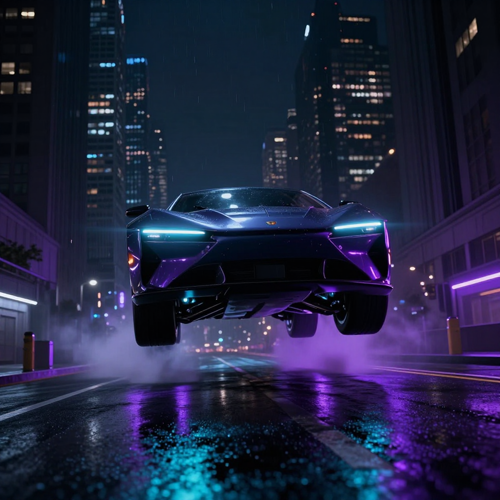
A low, wide sports car lifts off a rain-slicked boulevard, thrusters glowing under the chassis, tower lights falling away beneath it. The Tesla flying car look - dark roadster, cold gas jets, controlled landing - is the shot that made feeds stop scrolling after the October 2026 Roadster demonstration.
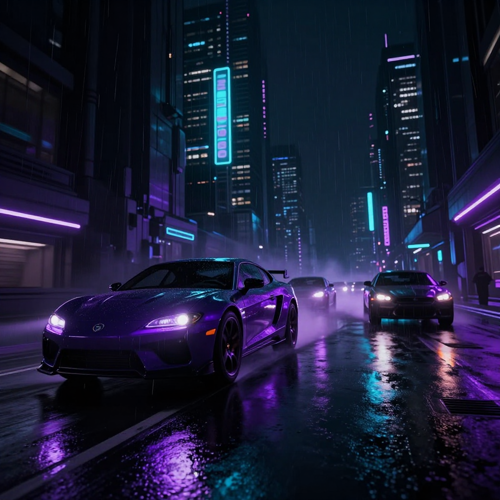
A pack of sports cars lines a rain-slicked neon boulevard - the frame right before lift-off, when the thrusters light under the chassis and the street starts to drop away. Slow, smooth and oddly calming, this is the ASMR side of flying car video content.
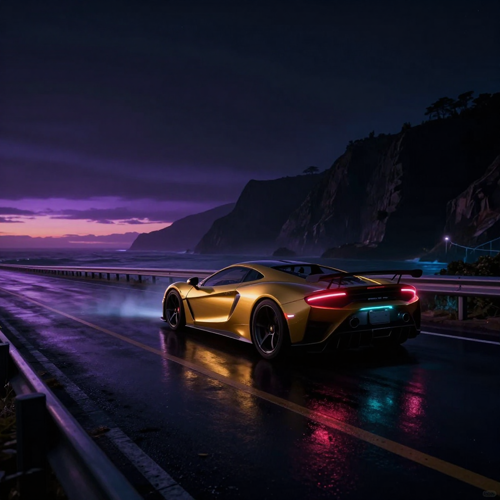
Sunset highway, open water on one side, and a car building speed along the guardrail - the beat just before it peels off the asphalt into a low glide across the bay. Daylight scenes read as travel footage rather than science fiction, which is exactly why a daytime flying car video travels further.
Same idea, four different moods. Swap the light, the weather and the camera, and one flying car video concept turns into a week of posts without reshooting anything.
Short-form creators started the trend; everyone else caught up once the format proved it could hold attention to the last second.
Feedback from the people posting these clips daily - channel runners, automotive teams and filmmakers who need a hover shot this week, not next quarter.
“The hover is what sells it. The car stays dead stable while the city slides underneath, so my flying car video reads as a real shot instead of a render.”
“We tested four visual directions for a launch teaser in one afternoon. Before this, a single hover shot meant a CGI artist and a two-week queue.”
“I storyboard the takeoff with a generated clip first. If the camera move works in the flying car video, I know it works in the pitch.”
What a flying car video actually is, how the generator builds the shot, whether the Tesla flying car is real, and how to post these clips without getting flagged.
A flying car video is a short AI-generated clip in which a car leaves the road and holds a believable hover or flight path - a vertical takeoff above a rain-slicked boulevard, a low glide over a coastal highway, a banking turn between towers. The appeal is the contrast: a vehicle everyone recognises doing something physics does not allow. A flying car video generator builds that shot from a text prompt or from a photo of a car, handling the lift, the motion and the camera move in one pass, so there is no 3D package, no tracking and no compositing timeline involved.
Describe three things: the car, the place, and the moment it lifts. A single line such as a dark sports car taking off vertically from a wet boulevard at midnight, neon reflections on the paint, camera tracking from behind, is enough to start. Then add the camera behaviour - orbit, pull-back, low tracking shot - and keep the duration short, roughly 8 to 15 seconds. Generate two or three takes and keep the one where the hover stays stable; changing only the weather or the time of day produces a completely different flying car video from the same idea.
Yes. Upload a clear photo of the car and the image-to-video pass keeps its make, paint, wheels and stance while adding the lift - wheels dropping away, thrusters lighting under the chassis, ground detail falling behind as the car climbs. Daylight shots with the whole vehicle in frame give the cleanest result, and the same photo can be reused across clips so the car stays identical. Only use photos you own or have permission to use, and avoid images of people who have not agreed to appear.
In October 2026 Tesla staged a demonstration of the second-generation Roadster at a SpaceX test site in Texas. Reports of the event describe a cold-gas thruster package co-developed with SpaceX - compressed air held in carbon-wrapped tanks and released through nozzles around the body - plus an underbody fan system Tesla says produces more than 2G of downforce. What the demonstration showed was short hops, flips and a controlled landing rather than sustained flight, and aviation commentators described it as hopping more than flying. Tesla has said production is targeted for 2028. A Tesla flying car video is the generated version of that idea, and it needs no hardware at all.
Vertical 9:16, and short. Reels, TikTok and YouTube Shorts reward clips that hook in the first second and end before attention drops, which for this format usually means 8 to 15 seconds: ground contact, lift-off, hover, camera drift. Generating natively in 9:16 also avoids the crop that pushes the car out of frame when a landscape render is squeezed into a vertical feed. Square or 16:9 still makes sense when the clip is heading into a presentation, a YouTube intro or a website hero.
A car jump clip keeps the camera on a person sitting still while a vehicle flies over their head, so the shock is the timing. A flying car video puts the vehicle at the centre: it lifts, holds altitude and travels through a scene while the camera follows it. If the subject is the car and its flight path, a flying car video is the right format; if the subject is someone's reaction to a vehicle passing overhead, the car jump format is closer to what you want.
Treat it as yes. TikTok, Instagram and YouTube all ask creators to disclose AI-generated content, and several apply automated labels or a creator-declared setting. Disclosure also tends to help rather than hurt: the comments under flying car clips are full of people asking how it was made, and saying it up front turns that curiosity into engagement. Check each platform's current rules before posting, because they change.
Three reasons come up repeatedly. Recognition: a known car silhouette reads instantly, so viewers register the shot before they register that it is impossible. Motion: a slow, stable hover under a drifting camera is satisfying in the way ASMR footage is, and it holds people to the end of the clip. Format: at 8 to 15 seconds the whole arc lands inside the completion window short-form algorithms push. Add a recognisable badge or brand shape in the frame and the comments do the rest.
Yes, and it is one of the cheaper ways to get a hover shot into a campaign. Typical uses are teaser openers, concept reveals, event intros and product silhouettes lifted above a skyline. Keep the vehicle identical between shots when the clip is part of a series, never imply that a real product can fly, and disclose AI-generated content wherever the platform requires it. Because a flying car video can be generated in minutes, it also works well for testing several visual directions before a shoot is booked.
Fix the car first, then vary everything else. Repeat the same model, paint, wheels and stance in every prompt, and reuse one reference photo for image-to-video passes; change the city, the weather, the time of day and the camera move instead of the vehicle. Keeping a short saved prompt template makes it easy to produce a week of flying car video clips that cut together as one sequence rather than five unrelated renders. Believability matters as much as repetition: viewers pause these clips frame by frame, and a car that changes proportions between shots, or a hover with no visible lift hardware, thruster glow or ground detail reacting underneath, is the first thing they point out.
The flying car video effect sits inside a full AI video suite - pair it with other effects, tools and creation modes on Textideo.
Pick a street, write one line, and watch a car leave the ground. The flying car video generator handles lift, motion, light and camera, so you can post vertical clips to Reels, TikTok and Shorts the same afternoon. Open the effect on Textideo, generate a few takes, and export the one that flies.
Create Flying Car Video NowAvailable on Textideo · generate a few takes, keep the one that flies